Reminder: Columbia Society for Comparative Philosophy lecture on Truth and Argument in Ancient Chinese Philosophy Dec 6 @5:30pm

(A reminder about this upcoming lecture this Friday, December 6.)

THE COLUMBIA SOCIETY FOR COMPARATIVE PHILOSOPHY

Welcomes:

BRYAN VAN NORDEN (Vassar College)

With responses from:

TIMOTHY CONNOLLY (East Stroudsburg University)

Please join us at Columbia University’s Religion department on Friday, December 6, 2013 at 5:30 for his lecture called:

“Truth and Argument in Ancient Chinese Philosophy”

ABSTRACT:

Most informed students of comparative Chinese-Western philosophy would agree with the following four claims: 

  1. Chinese philosophy is almost always concerned with truths that have ethical and social implications, whereas Western philosophy is sometimes concerned with purely theoretical puzzle-solving.
  2. Nonetheless, historically speaking, most Western philosophers have in fact been motivated to philosophize by ethical and social concerns.  The trend toward theoretical puzzle-solving is largely characteristic of some 20th century philosophy, particularly in the English-speaking world.
  3. Aristotle invented the first form of formal, deductive logic in the West, whereas Chinese philosophers were much more interested in the complexities of ordinary language arguments.
  4. Nonetheless, philosophers in both China and the West give philosophical arguments – and sometimes structurally similar philosophical arguments – without needing to use formal logic.

Controversy remains, though, over the proper way to understand the role of “truth” in Chinese philosophy. Continue reading →

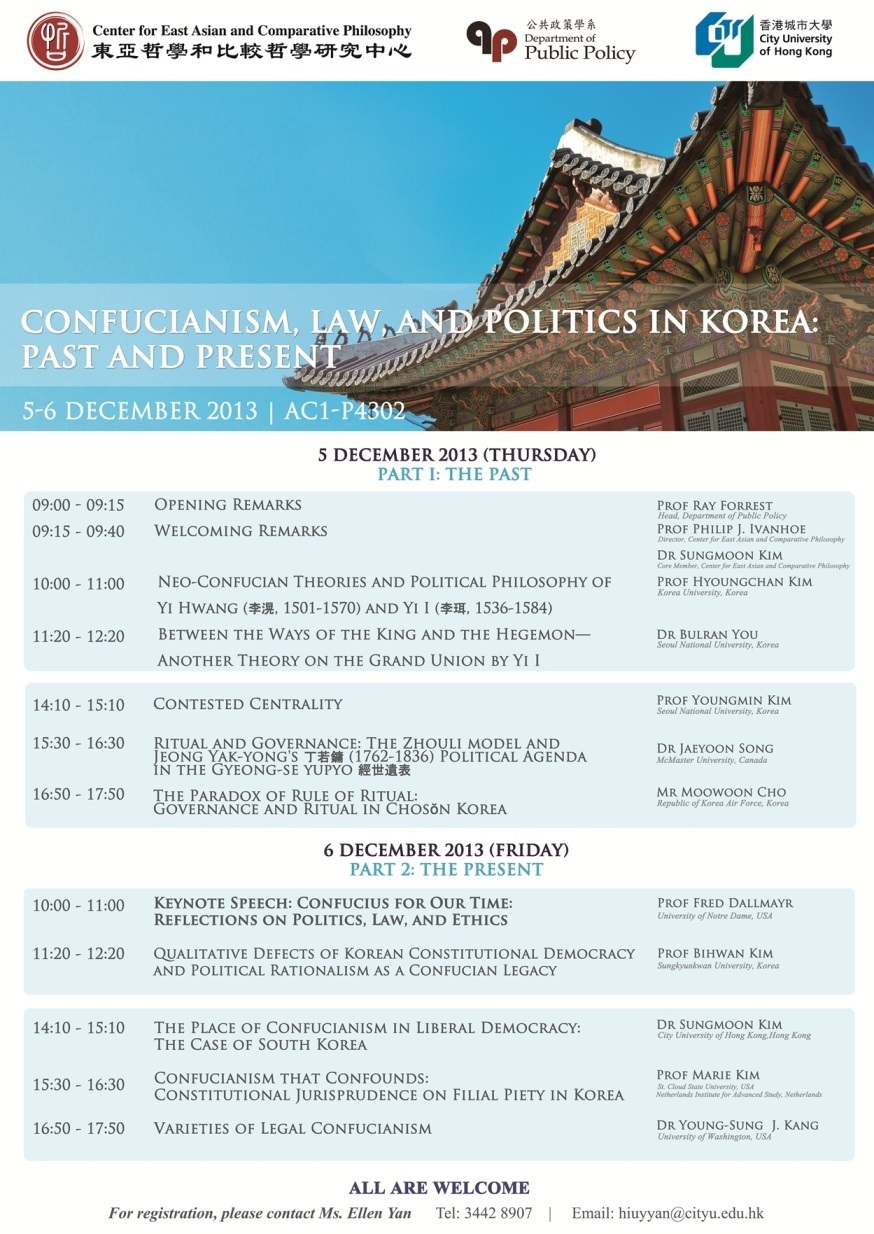
Conference 5-6 December in HK on Confucianism, Law, and Politics in Korea

Eirik Harris reports: We’re hosting a conference on “Confucianism, Law, and Politics in Korea: Past and Present” here at CityU that might interest some of the Warp, Weft and Way readers.  The Conference poster with list of speakers and topics is here: http://www6.cityu.edu.hk/ceacop/kpcp/conference_poster.jpg

Neo-Confucianism Seminar this Friday

The next session of the Columbia University Seminar on Neo-Confucian Studies will convene Friday, December 6, 2013 from 3:30 to 5:30pm in the Komoda Room of the Heyman Center for the Humanities at Columbia University.

Our presenter is Ellen Neskar of Sarah Lawrence College.  Her paper is titled “Dreams, Court Cases, and Confucians.”  Please contact the organizers for a copy.

Continue reading →

Classical Daoism – Is there Really Such a Thing? 4.3

Friend of the blog, Scott Barnwell, shares part 4.3 of his extensive study of classical Daoism.
You will find a lengthy PREVIEW below — footnote links send you to the article posted on his own blog. Comments are welcome here; please address comments to Scott.

___________________________________________________

Mysticism, Self-Cultivation and Longevity

Continue reading →

Immediate Job Opportunity

The Leiden University Institute of Philosophy is seeking to fill, on short notice, the position of Assistant Professor in Comparative Philosophy and History of Philosophy. They are particularly interested in a specialist of CHINESE PHILOSOPHY AND/OR BUDDHISM.

The appointment is for 19 hours per week (i.e., half-time) for a period of two years, but opportunities for an extension of the position in time and duration may arise. Note that the deadline for applications is next week, December 2, and the position is to begin in January or February 2014.

For further details please see below.

Continue reading →

Van Norden on Methodology

As a follow-up to some of the issues raised at NECCT 2, Bryan Van Norden has posted some thoughts on his little-used personal blog: “On the Historical Composition and Dating of Texts.” Here is his conclusion:

We cannot start slicing and dicing a text into sections belonging to different authors or different eras simply [because] we notice in it theoretical tensions, evidence of editing, the use of one word in multiple senses, or heterogeneity of subject matter.   I worry when I see what appears to me, at least, to be the quick jump to the conclusion that a text is historically composite before any substantial effort has been made to engage the plausibility of philosophical explanations of the text as a coherent whole.  In short, we intellectual historians are admittedly sometimes too quick to jump over textual issues in our excitement to get to systematic philosophical interpretation. However, you cannot address this problem by leaping to the conclusion that a text is historically composite every time you encounter a passage that you don’t immediately know how to reconcile with what you thought you understood before.

Bryan says that he’s unlikely to be able to answer any comments posted on his blog, but anyone who’d like to comment over here is more than welcome to do so.

CFP: Confucianism and Feminism

CALL FOR PAPERS AND PROPOSALS

Confucius and Feminism

Co-editors: Mathew A. Foust (Central Connecticut State University) & Sor-hoon Tan (National University of Singapore)

Chenyang Li’s path-breaking The Sage and the Second Sex (2000) challenged the traditionally received notion of Confucianism abetting the oppression of women in three ways.  With studies of a wide range of Confucians, including Mencius, Xunzi, and Li Zhi, and historical periods stretching from fifth century BCE to sixteenth century, contributions to the edited volume suggested that women’s situations in Chinese history were not as bad as has been supposed; that core Confucian teachings have had little to do with anything bad about their situations; and that Confucianism offers an ethical vision compatible with Feminism.

Continue reading →