Category Archives: Confucianism

Two New Books

Two recently published books deserve our attention:

P.J. Ivanhoe, Confucian Reflections: Ancient Wisdom for Modern Times (Routledge, 2013); this rich and concise book “…argues that the Analects is as relevant and important today as it has proven to be over the course of its more than 2000 year history, not only for the people who live in East Asian societies but for all human beings.”

Joseph Chan, Confucian Perfectionism: A Political Philosophy for Modern Times (Princeton, 2013); a long-awaited major statement of Chan’s modern Confucianism, it “…examines and reconstructs both Confucian political thought and liberal democratic institutions, blending them to form a new Confucian political philosophy.”


New Articles Coming at SEP

Karyn Lai and Sor-hoon Tan have recently joined the Stanford Encyclopedia of Philosophy as new editors in the Chinese philosophy area, and are undertaking an ambitious program to increase the number of articles on Chinese philosophy from the current dozen up to nearly 40. The SEP’s lack of content in Chinese philosophy has been a topic of discussion here in the past, so this is exciting news. Articles anticipated to come out over the next year include: Chinese Philosophy: Social and Political Thought, Chinese Epistemology, Chinese Metaphysics, Chinese Logic, Chinese Philosophy of War and Peace, Legalism in Ancient China, Tiantai Buddhism, Chan Buddhism, Han Dynasty Syncretism, Song-Ming Confucianism, Qing dynasty philosophy, Contemporary Chinese Philosophy.

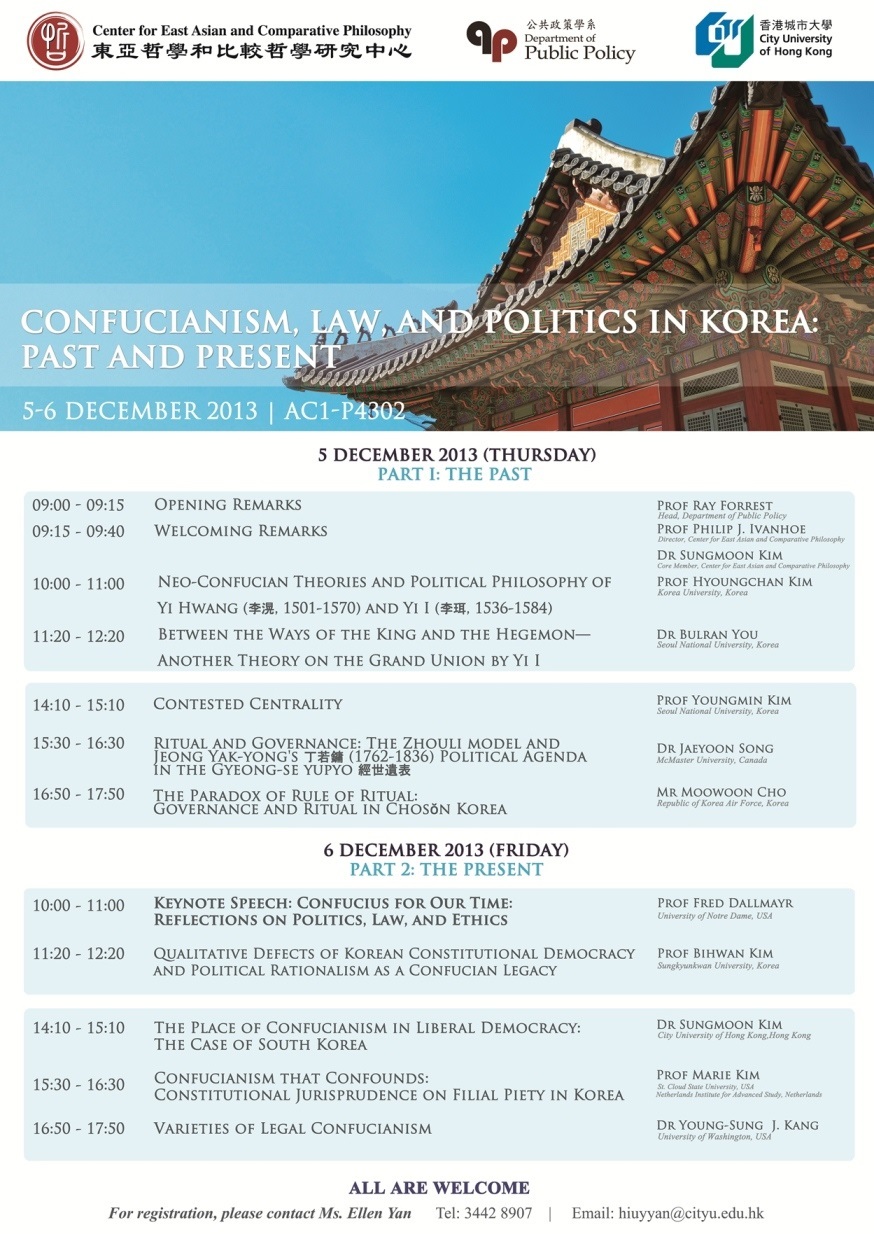
Conference 5-6 December in HK on Confucianism, Law, and Politics in Korea

Eirik Harris reports: We’re hosting a conference on “Confucianism, Law, and Politics in Korea: Past and Present” here at CityU that might interest some of the Warp, Weft and Way readers.  The Conference poster with list of speakers and topics is here: http://www6.cityu.edu.hk/ceacop/kpcp/conference_poster.jpg

Louis CK and Mengzi

This clip (below) from Louis CK’s most recent interview on Conan made a splash on social networks.  The whole thing is pretty funny, but the first minute or so reminded me of Mencius 1A7.

Part of what prevents the king in 1A7 from becoming a genuine king in that passage is his disconnect from his subjects.  He feels the suffering of the ox and this tugs at his sprout of compassion.  By contrast, he doesn’t see the suffering of his subjects, so he feels no sympathy for them and fails to treat them benevolently.

Louis CK raises the same general issue for children today and cellphone use. Continue reading →

New Book by Chenyang Li

From Routledge comes this announcement about a book by one of our blog contributors, Chenyang Li. There is also information about a 20% discount promotion from Routledge in this promotional flier.

________________________________________________

The Confucian Philosophy of Harmony Routledge 2013

by Chenyang Li

Harmony is a concept essential to Confucianism and to the way of life of past and present people in East Asia. Integrating methods of textual exegesis, historical investigation, comparative analysis, and philosophical argumentation, this book presents a comprehensive treatment of the Confucian philosophy of harmony.

The book traces the roots of the concept to antiquity, examines its subsequent development, and explicates its theoretical and practical significance for the contemporary world. It argues that, contrary to a common view in the West, Confucian harmony is not mere agreement but has to be achieved and maintained with creative tension. Under the influence of a Weberian reading of Confucianism as “adjustment” to a world with an underlying fixed cosmic order, Confucian harmony has been systematically misinterpreted in the West as presupposing an invariable grand scheme of things that pre-exists in the world to which humanity has to conform. The book shows that Confucian harmony is a dynamic, generative process, which seeks to balance and reconcile differences and conflicts through creativity.

Continue reading →

Bard College Admissions and the Analects

An article in today’s New York Times discusses Bard College’s decsion to allow students to apply to Bard via submission of four 2,500 word essays, in lieu of the standard list of test scores and high school grades. My eye was drawn to the first of the questions listed in the article:

In “The Analects,” Confucius identifies the cardinal virtue of ren (variously translated as goodness, humanity, benevolence) with many different attitudes and behaviors. Yet Confucius also says, “There is one thread that runs through my doctrines.” Commentators differ about what that one thread is. What, in your opinion, could that one thread be? How does that one thread tie together the wide range of moral values that Confucius celebrates in “The Analects”? Support your answer by interpreting specific passages from the text.

This is perhaps less surprising, in light of the fact that Bard for several years used the Analects as a key reading in its First-Year Seminar program, and continues to include readings from classical Chinese thought.

Two New Books Related to Confucianism

53088

Confucian Rituals and Chinese Villagers:
Ritual Change and Social Transformation in a Southeastern Chinese Community, 1368-1949

Brill 2013

In Confucian Rituals and Chinese Villagers, Yonghua Liu presents a detailed study of how a southeastern Chinese community experienced and responded to the process whereby Confucian rituals – previously thought unfit for practice by commoners – were adopted in the Chinese countryside and became an integral part of village culture, from the mid fourteenth to mid twentieth centuries.

The book examines the important but understudied ritual specialists, masters of rites (lisheng), and their ritual handbooks while showing their crucial role in the ritual life of Chinese villagers. This discussion of lisheng and their rituals deepens our understanding of the ritual aspect of popular Confucianism and sheds new light on social and cultural transformations in late imperial China.

Yonghua Liu, Ph.D. (McGill, 2004), is Professor of History at Xiamen University, China. He has published over two dozen articles on economic, social, and cultural history of late imperial China.


Confucian Marxism:

A Reflection on Religion and Global Justice

Brill 2013

Buttressed by an autocratic system, China’s colossal economic growth over the past decades seems to have had the paradoxical effect of undermining the foundation of Western domination but at the same time invigorating Eurocentricism. In particular, it highlights the current relevance of the central conviction of Weber’s Orient: the absence of civic roots in non-Western societies will create a kind of “uncivic” capitalist system in which one has no choice but to seek to compensate for instabilities through authoritarian institutions. Does this mean that the West may alone afford to harmonize political stability with the universalistic ideal of justice as the basic structure of society? If not, how then is it possible to develop a notion of the primacy of social justice that transcends the limits of liberal democracy? This book aims at addressing these timely questions by drawing on “Confucian Marxism”—a distinctive perspective on civil society.

Weigang Chen, Ph. D. (Religious Studies, Harvard University 2000), is on the faculty of philosophy and religious studies at University of Macau, with research interests in religion and global politics. He is a member of the editorial board of Dao: A Journal of Comparative Philosophy.